



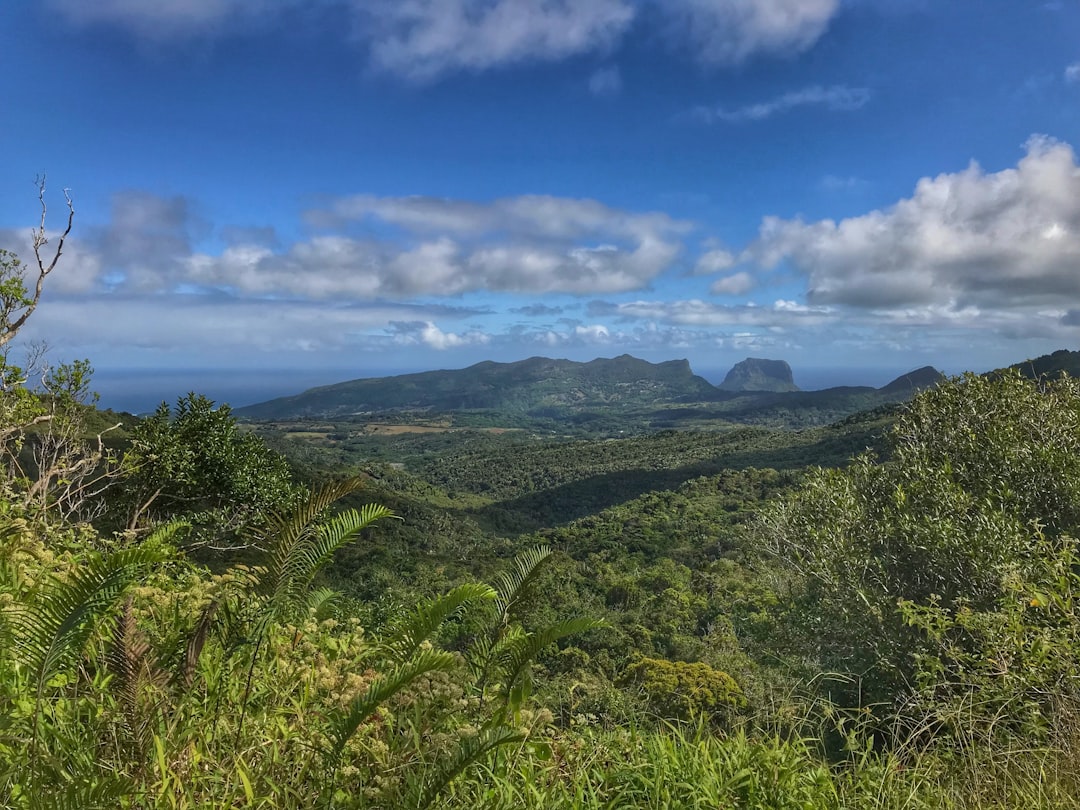
Mauritius's volcanic backbone means the island packs a surprising amount of vertical drama into a small footprint. Sharp basalt peaks, forested ridgelines and old lava domes rise abruptly from the coastal plain, and because the island is so compact, almost every summit trail starts within an hour of the beach. Climbing even a modest peak here changes how the island reads: the reef appears as a pale line separating lagoon from open ocean, and the whole country resolves into a single green speck in a vast blue expanse.
Le Pouce
Rising behind Port Louis, Le Pouce ("The Thumb") is a distinctive basalt dome that reaches 812 metres, making it the third-highest point in Mauritius after Piton de la Petite Rivière Noire and Pieter Both. The trail climbs from the Moka side through forest and grassland to a narrow, exposed summit with sweeping views over the capital and the Moka Range. It is a historically storied climb, too — Charles Darwin hiked to the top during the Beagle's 1836 stopover and wrote about the view in his journal. Allow three to four hours return; the going is moderate, with a steeper final push.
Le Morne Brabant
The UNESCO World Heritage-listed Le Morne Brabant is the island's signature hike, a dramatic basalt monolith rising 556 metres straight from the lagoon on the south-west coast. Its history is significant: the mountain is a memorial to enslaved people who sought refuge on its slopes, and the site was inscribed by UNESCO in 2008 for that history. Hiring a guide is not a legal requirement, but it is strongly recommended — the upper section involves steep, rocky scrambling, and a guide adds both safety and historical context. Budget four to five hours return for a moderate-to-challenging climb, rewarded by one of the best lagoon views on the island.
Corps de Garde
Overlooking Rose Hill and Quatre Bornes in the centre-west, Corps de Garde is a 720-metre volcanic peak with a short, steep trail that finishes with some light scrambling along a grassy ridge to a rocky summit. It is less visited than the more famous peaks, protected in part by a small nature reserve established in 1951, and easily combined with a morning in the nearby towns. Expect two to three hours return on a moderate but punchy trail.
Lion Mountain
Named for the leonine silhouette it forms when viewed from Mahébourg, Lion Mountain rises above the historic bay of Grand Port in the south-east — the site of the 1810 Battle of Grand Port, France's only naval victory commemorated on the Arc de Triomphe. The trail eases in through forest before a steep final climb along the mountain's rocky spine, with the summit looking straight down over the battle site. Allow around three hours return for a moderate-to-challenging walk.
Hiking Sensibly
- Start early, ideally by 6:00 AM, to avoid the afternoon heat and cloud that often rolls in over the peaks.
- Carry at least two litres of water per person and wear shoes with real grip — volcanic trails turn slick when wet.
- Trail markings are inconsistent; download a GPS track from AllTrails or Wikiloc beforehand, or hire a local guide.
- Apply reef-safe sunscreen and insect repellent before setting out.
None of these hikes require technical climbing skill, but all reward a reasonable level of fitness and respect for changeable mountain weather — a fair trade for some of the best views in the Indian Ocean.